Please read first. This article is general information about U.S. immigration law as of November 2026. It is not legal advice about your situation, and reading it does not make you a client of Ratkowski Law PLLC. Whether you should go to a particular appointment depends on facts this article cannot know, so talk to an immigration lawyer before you decide.
The Short Answer
A Form G-56 "call-in letter" from ICE is a request, not an order. By itself, it creates no legal duty to appear and carries no penalty for staying home. Missing it cannot get you ordered deported in your absence, because only an immigration judge can do that, and only for a missed court hearing.
That changes if something else already requires you to report. If ICE released you on an order of supervision, on recognizance or parole with reporting conditions, or into an Alternatives to Detention (ATD) program, your release papers require you to go, and the G-56 may just be how ICE schedules the visit. If someone posted an immigration bond for you, ICE can demand that the person who posted it bring you in. A subpoena (Form I-138) is also different from a G-56, although even a subpoena needs a federal court order before anyone can be punished for ignoring it.
Not being required to go is not the same as being safe from arrest. ICE can arrest people at home, at work, or in public whether or not they answered a letter. The real decision is about risk, and that is a conversation to have with a lawyer who knows your file.

What a G-56 Call-In Letter Is
A G-56 is a one-page Department of Homeland Security form titled "Call-In Letter." ICE and Homeland Security Investigations (HSI) use it to ask someone to come to an ICE office at a set date and time. Its key sentence asks the person to come "in connection with an official matter." You can see a blank copy on ICE's website.
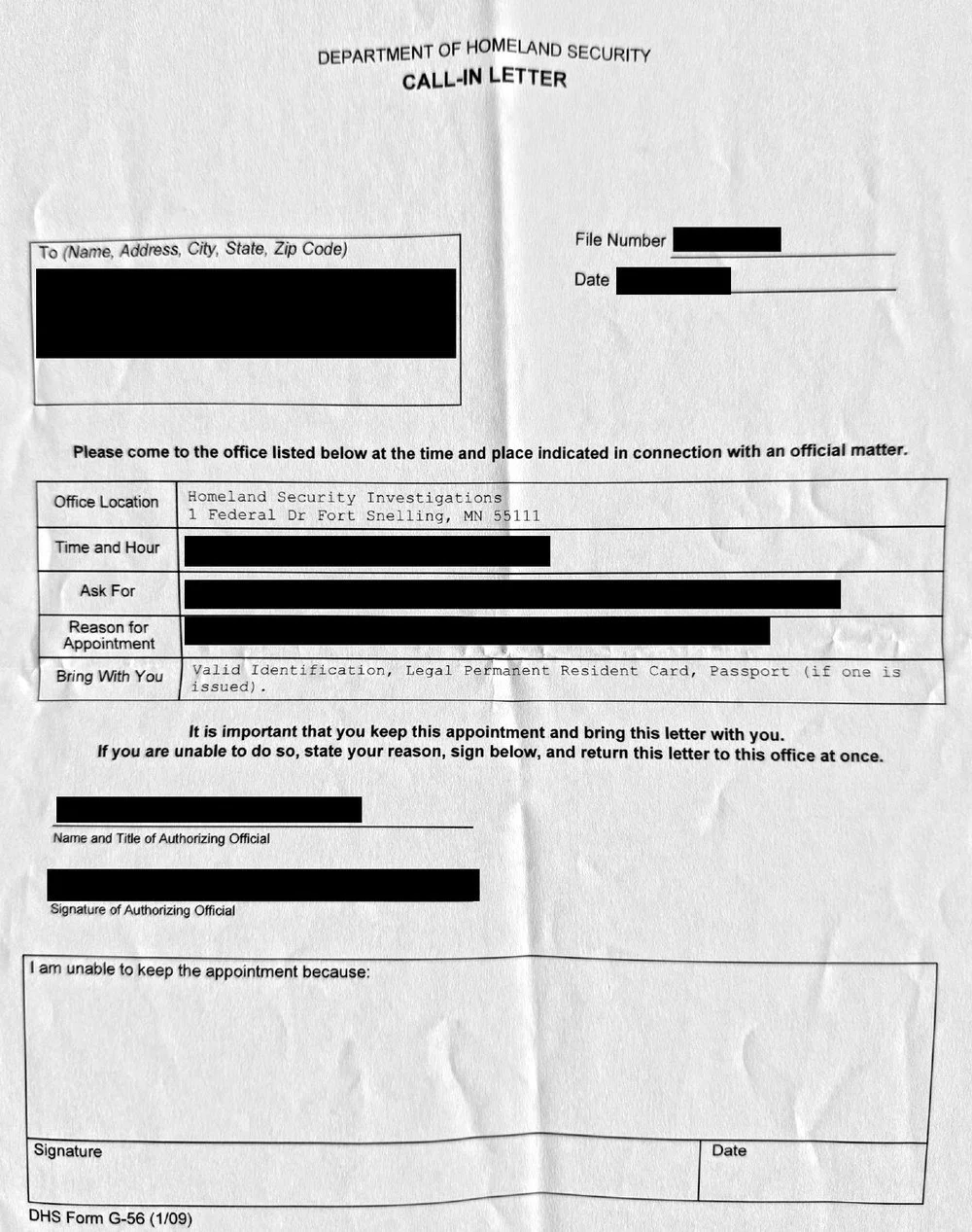
A real Form G-56 that Homeland Security Investigations sent to one of our clients, with identifying details blacked out.
Read the letter closely and notice what is missing.
It cites no law that requires you to come.
It does not say anything will happen to you if you stay home.
It is not signed by a judge, and it is not a court order.
It usually has a tear-off section where you can explain why you cannot keep the appointment.
The letter may say the appointment is important, and some arrive with no signature at all. Neither fact changes the analysis. No statute or regulation gives a G-56 the power to compel attendance, so a signature would not make it binding. A missing signature matters mostly as evidence later that no official took responsibility for the request.
The exception that matters most. ICE also uses the G-56 to schedule check-ins for people who already must report, such as people released on parole, in an Alternatives to Detention program, or with a Notice to Report. For those people, the duty to go comes from their release papers, and the G-56 just sets the date. So the first question is always the same: what papers did you receive when you were released, and what do they require?
The same is true of phone calls, text messages, and messages through an ICE monitoring app. A call asking you to come in has no more legal force than a G-56, unless your release conditions require you to respond to ICE's instructions.
When ICE Really Can Require You to Show Up
There are four situations where you have a real obligation to report to ICE, or where someone else does on your behalf. Two more, immigration court and USCIS, are often confused with ICE but follow different rules.
1. You have a final order and are on an Order of Supervision
If an immigration judge ordered you removed and ICE released you on an Order of Supervision (Form I-220B), you must report as directed. Federal law requires people under supervision to appear periodically, and willfully failing to comply is a federal crime punishable by up to one year in prison. ICE can also revoke your supervision and detain you. If this is you, go, and talk to a lawyer before you do.
2. You were released with written reporting conditions
Many people were released with papers that require them to report. Common examples are an Order of Release on Recognizance (Form I-220A), a parole document with reporting terms, a Notice to Report, or enrollment in an Alternatives to Detention program (a phone app, check-ins, or an ankle monitor). Breaking these conditions is not a crime, but ICE can use it as a reason to revoke your release and detain you. Read your papers, and follow them.
3. Someone posted an immigration bond for you
An immigration bond is a contract between ICE and the person who paid it, called the obligor. If ICE wants the person released on bond to come in, it sends the obligor a demand on Form I-340, "Notice to Obligor to Deliver Alien." If the obligor does not produce you, ICE can declare the bond breached and keep the money, and it may argue the breach is a reason to detain you. A G-56 mailed to you is not an I-340. If the person who paid your bond receives an I-340, call a lawyer right away.
4. You were served a subpoena (Form I-138)
ICE officers can issue subpoenas on Form I-138. A real subpoena cites the federal law that authorizes it and warns about contempt of court. Even so, ignoring an ICE subpoena is not itself punishable. ICE has to ask a federal judge for an order, and only disobeying the judge's order can lead to contempt. You keep your Fifth Amendment right to remain silent throughout. If you receive one, have a lawyer respond for you.
Not ICE: immigration court and USCIS
Immigration court hearings are mandatory. If you miss a hearing after proper notice, the judge can order you deported in your absence. Never skip court.
USCIS interviews and fingerprint appointments are run by a different agency. If you miss one, USCIS can treat your application as abandoned and deny it.
Quick Guide: Do You Have to Go?
Find the situation that matches yours. If more than one fits, follow the stricter one.
Under a final order and released on an Order of Supervision: Yes, you must go. If you don't, you risk a federal misdemeanor charge and re-detention.
Released with written reporting conditions (I-220A, parole terms, Notice to Report, Alternatives to Detention): Yes, you must go. If you don't, ICE can revoke your release and detain you.
Out on bond, and the person who paid it received a Form I-340: The person who paid must bring you in. If not, the bond money can be forfeited, and ICE may use that to justify detention.
Out on bond with no reporting conditions, and you only received a G-56: No. There is no legal penalty, though ICE may treat you as a priority for arrest.
In immigration court and released without conditions: Not to ICE, but always go to court. Missing ICE carries no penalty; missing court can lead to a deportation order.
A green card holder who is not in removal proceedings: No. There is no legal penalty.
A refugee who has not yet received a green card: Not to ICE, but keep every USCIS appointment. See the refugee section below.
Not in removal proceedings and never released on conditions: No. There is no legal penalty, though ICE may still try to arrest you elsewhere.
Served a Form I-138 subpoena: Not until a judge orders it. Contempt is possible only if you disobey a court order.
Scheduled for a USCIS interview or fingerprints: Yes, if you want your application decided. Missing it can get the application denied as abandoned.
What Not Going Does, and Does Not, Protect You From
If a G-56 is the only thing asking you to come in, declining it is not a crime, carries no fine, and cannot lead to a deportation order in your absence. It also means you are not walking into a federal building where an arrest takes no effort. In our practice, we have seen call-in appointments end in arrest and in service of a Notice to Appear the same day.
Declining does not stop ICE from arresting you somewhere else. Officers can arrest people at home, at work, or in public with an administrative warrant, and sometimes without one. Declining also does not make an existing immigration case go away.
If you are out on bond, ICE may later argue that skipping the appointment shows you are a flight risk. That argument is weak when the letter required nothing, your address is current, and you are actively fighting your case. It is still an argument ICE may make, which is one reason to talk to a lawyer before you decide.
The bottom line is that, for most people who receive only a G-56, the question is not "Am I required to go?" It is "What is my risk if I go, and what is my risk if I don't?" That answer depends on your history, your release papers, where you live, and how strong your case is.
Special Situations
Green card holders
A lawful permanent resident who is not in removal proceedings has no general duty to report to ICE. Your ongoing duties are to carry your green card if you are 18 or older and to report any change of address within 10 days.
We have seen HSI send G-56 letters to green card holders as part of voter-registration investigations. Those appointments are part of a criminal investigation. Anything you say can be used both in a criminal case and in a deportation case. You have the right to remain silent, and lying to a federal agent is a separate crime. Talk to a lawyer before you say anything.
Refugees who have not yet received a green card
Refugees are expected to apply for a green card after one year in the United States, and that process runs through USCIS. Keep every USCIS appointment.
In February 2026, DHS adopted a policy claiming it could arrest and detain refugees who had not yet adjusted to green card status. A federal court in Massachusetts stayed that policy on March 23, 2026, while the case continues. If USCIS has tried to terminate your refugee status, your situation is more complicated, and the deadlines can be short. In October 2026, DHS cut the time to respond to a termination notice to 10 days, and that rule is being challenged in court, which has temporarily paused it while the case proceeds. Get legal help immediately.
People with a case in immigration court or on appeal
A G-56 does not change your court obligations. You cannot be ordered deported in your absence for missing an ICE appointment. You can be for missing court, so never miss a hearing. If you move, file a change of address with the immigration court (Form EOIR-33) within five days, or with the Board of Immigration Appeals if your case is on appeal.
If the government has filed a new court case you have not received
The government can file a case in immigration court before you ever receive the papers. A filed case still does not make a G-56 mandatory, but it can mean there is a court hearing you must attend.
Check whether a case exists. Use EOIR's Automated Case Information system online, or call 1-800-898-7180, and enter your A-number.
Make sure the court can reach you. Court notices can be mailed to the last address you gave the government. If you never gave an address, you can be ordered removed for missing a hearing without any notice at all.
A lawyer can step in. Your lawyer can file an appearance in the court case to receive the papers and hearing notices directly. That is not the same as reporting to ICE.
People who entered without inspection
If you entered the United States without being inspected and ICE arrests you, whether you can get a bond hearing currently depends on where you live. Federal appeals courts disagree. The Eighth Circuit, which covers Minnesota, has sided with the government, while the Ninth Circuit, which covers much of the West, has not. The Supreme Court agreed in October 2026 to decide the question. This affects how much is at stake if an appointment turns into an arrest.
Unsigned letters
An unsigned G-56 is no less binding than a signed one, because neither is binding on its own. Keep the letter and the envelope; a lawyer may want them later. A subpoena is different. A Form I-138 must be issued by an authorized official, so an unsigned subpoena is a problem for the government.
Practical Checklists
If you decide not to go
Have a lawyer read your release papers to confirm nothing requires you to report.
Make sure your address is current everywhere. File Form AR-11 with USCIS within 10 days of any move, and Form EOIR-33 with the court within five days if you have a case. A missed address change can be a crime and a reason for removal, and it is ICE's easiest argument that someone is hiding.
Keep the letter and its envelope.
If someone paid a bond for you, ask whether that person has received anything from ICE.
Never miss an immigration court hearing, and check regularly whether one has been scheduled. The government can file a case before you receive the papers, so look up your A-number online or call 1-800-898-7180.
Make a safety plan. Give a family member your A-number, your country of birth, and your lawyer's phone number, and keep important documents where they can find them.
If you receive a real subpoena (Form I-138), do not ignore it. Have a lawyer respond.
If you decide to go
Talk to a lawyer first, and bring one if you can. ICE may not let your lawyer go with you past the lobby.
Bring your release papers, any bond paperwork, and proof of any pending court case or application.
You may decline to answer questions beyond your identity. Do not lie, and do not sign anything you do not understand.
Before you walk in, leave your lawyer's information, your A-number, and any childcare or medication plans with someone you trust.
For Lawyers and Judges: The Legal Framework
We know of no statute or regulation that attaches any consequence to declining a G-56 on its own. The compulsory mechanisms are separate, and each has its own source.
No general summons power. Section 1357(a)(1) authorizes officers to interrogate without a warrant but imposes no duty to appear or answer. DHS's regulation says an officer, "like any other person, has the right to ask questions of anyone" so long as the officer does not restrain a person "not under arrest, to walk away." 8 U.S.C. § 1357(a)(1); 8 C.F.R. § 287.8(b)(1).
Subpoenas. Immigration officers may subpoena witnesses, but only on Form I-138 issued by a listed official. Refusal leads to a request for a district court order, and only disobedience of that order is punishable as contempt. 8 U.S.C. § 1225(d)(4); 8 C.F.R. § 287.4.
Orders of supervision. Periodic reporting is mandatory after a final order, and willful noncompliance is a misdemeanor. 8 U.S.C. §§ 1231(a)(3), 1253(b); 8 C.F.R. § 241.5(a)(1).
Pre-order release. Reporting terms in an I-220A, parole document, or ATD enrollment are release conditions. Breach supports revocation, not prosecution. 8 U.S.C. § 1226(a)–(b); 8 C.F.R. § 236.1(c)(9).
Bonds. The delivery obligation runs to the obligor through a Form I-340 demand, and a substantial violation is a breach. On re-detention, the bond is canceled "unless a breach has occurred." Form I-352; 8 C.F.R. § 103.6(e), (g); 8 C.F.R. § 236.1(c)(9).
Re-detention after an IJ bond. DHS should not alter an immigration judge's custody determination "absent a change of circumstance." Matter of Sugay, 17 I&N Dec. 637, 640 (BIA 1981); Panosyan v. Mayorkas, 854 F. App'x 787, 788 (9th Cir. 2021) (mem.). Declining a non-compulsory invitation is a thin basis for finding changed circumstances.
In absentia orders and charging documents. Only a missed hearing before an immigration judge supports an in absentia order. An NTA may be served by mail when personal service is not practicable, and jurisdiction vests when it is filed, but the filed NTA must carry a certificate showing service. Mail service suffices on proof of attempted delivery to the last address provided, and no notice is required if the respondent never provided one. 8 U.S.C. §§ 1229(a)(1), (c), 1229a(b)(5)(A)–(B); 8 C.F.R. § 1003.14(a).
USCIS appointments. A missed interview or biometrics appointment results in abandonment and denial. 8 C.F.R. § 103.2(b)(13)(ii).
Refugees. The § 209(a)(1) "return or be returned to the custody" clause applies only to a refugee "whose admission has not been terminated." DHS's 2026 refugee detention memos are stayed under 5 U.S.C. § 705. 8 U.S.C. § 1159(a)(1); Jean A. v. Noem, No. 3:26-cv-30031, 2026 WL 805207 (D. Mass. Mar. 23, 2026); see also Matter of D-K-, 25 I&N Dec. 761 (BIA 2012) (refugees are admitted and charged under § 237).
Detention of people present without admission. The circuits are split on whether § 1225(b)(2)(A) mandates detention of noncitizens arrested in the interior. Compare Herrera Avila v. Bondi, No. 25-3248 (8th Cir. Mar. 25, 2026), with Rodriguez Vazquez v. Bostock, No. 25-6842 (9th Cir. July 30, 2026). The Supreme Court granted certiorari in Rhoney v. Barbosa da Cunha, No. 26-104 (Oct. 1, 2026).
Counsel at the appointment. The right to representation attaches "[w]henever an examination is provided for" in Chapter I of Title 8. Whether a call-in qualifies is unsettled in practice. 8 C.F.R. § 292.5(b).
Advising clients. A lawyer may "discuss the legal consequences of any proposed course of conduct with a client," and bona fide legal representation falls outside the federal obstruction chapter. Minn. R. Prof. Conduct 1.2(d); 18 U.S.C. § 1515(c).
Talk to a Lawyer Before You Decide
The general rules above are a starting point, not an answer for your case. Small facts change the advice, such as a condition buried in your release papers, a bond someone else signed, an old order you did not know about, or a criminal record that affects detention. A consultation is where we review your papers and talk through those caveats.
Ratkowski Law PLLC represents people in immigration court, before the Board of Immigration Appeals, and in federal court, including habeas cases challenging immigration detention.
Ratkowski Law PLLC
332 Minnesota Street, Suite W1610, St. Paul, MN 55101
651-755-5150 · nico@ratkowskilaw.com
Disclaimer
This article provides general information about U.S. immigration law and is not legal advice. Reading it, or contacting our office about it, does not create an attorney-client relationship. Immigration law and enforcement policy change quickly, and the court decisions described here may be appealed, stayed, or reversed. This article reflects the law as of November 23, 2026. How the law applies to you depends on facts we have not reviewed, so do not act, or decide not to act, based on this article alone. Consult a qualified immigration attorney about your specific situation. Past results do not guarantee a similar outcome in any other matter.